Most of the confusion around herbs and spices comes from treating them as one category. They are not. A jar of dried oregano and a bunch of basil from the windowsill behave completely differently in a pan, and the spice rack follows its own rules again. Once you understand why, you stop ruining good food by adding the right thing at the wrong moment.
The basic split: tender herbs, hardy herbs, spices
Think in three groups.
- Tender, soft-leaf herbs (basil, coriander, parsley, mint, dill, chives, tarragon). These live in their volatile oils, which boil off in seconds. They are almost always best fresh, and added at the very end or raw.
- Hardy, woody herbs (rosemary, thyme, oregano, bay, sage, marjoram). These hold up to long cooking and dry well. Dried versions are genuinely useful and sometimes better suited to a slow braise than fresh.
- Spices (cumin, coriander seed, cinnamon, cardamom, peppercorns, cloves, chilli). These are seeds, bark, roots and pods. They are nearly always used dried, and they want heat and time to wake up.
Get a feeling for which group you are dealing with and most decisions answer themselves.
When fresh genuinely wins
For the soft herbs, fresh is not a luxury, it is the whole point. Dried basil tastes of hay. Dried parsley tastes of nothing much. If a salad, a salsa, a yoghurt sauce or a finishing scatter calls for these, buy them fresh or leave them out.
The other rule for soft herbs: add them late. Stir torn basil into a sauce off the heat. Pile coriander and mint over a finished plate rather than cooking it in, the way you would with a bang bang prawn salad, where the raw herbs are doing half the work. Heat is the enemy here. Thirty seconds in a hot pan and the fragrance is gone.
Stalks are worth keeping. Coriander and parsley stems carry plenty of flavour and stand up to longer cooking than the leaves, so chop them finely and add them early, then save the leaves for the end.
When dried earns its place
Dried hardy herbs are not a sad compromise. Drying concentrates them, so a teaspoon of dried oregano can carry more punch than the same volume of fresh, and it releases slowly over a long simmer. In a tomato sauce, a stew or a marinade that sits for hours, dried oregano, thyme and bay do exactly what you want.
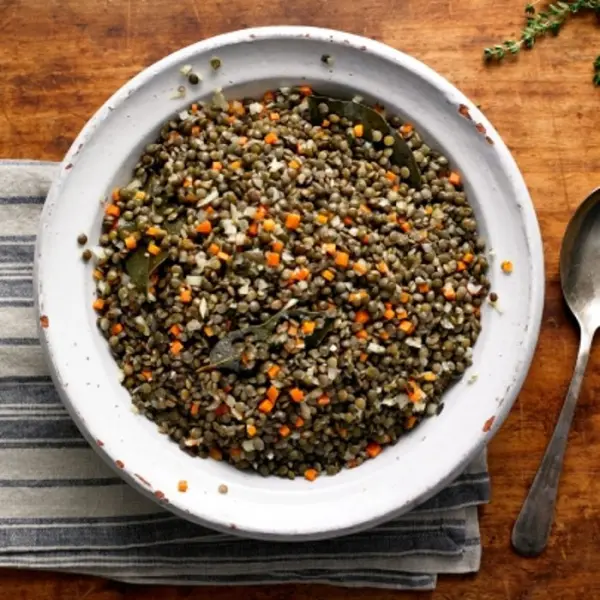
Dried also suits anything where you need the flavour distributed through the whole dish from the start. A pot of French lentils with garlic and thyme works happily with dried thyme stirred in early; the lentils have time to drink it up. A long braise like coq au vin leans on bay and dried or woody herbs that can survive an hour in the pan without turning to mush.
One caveat: dried herbs do not last forever. Most lose their guts after about a year in the jar. If your dried oregano smells of dust rather than oregano, it is doing nothing for your cooking. Buy small amounts and replace them.
Spices: toast them, and mind the timing
Spices are where the biggest flavour gains hide, and where the most common mistake lives. Tipping ground spices straight into a wet sauce gives you a raw, slightly bitter, powdery taste. Spices need fat and heat to bloom.
Two reliable methods:
- Toast whole spices dry, then grind. Warm cumin and coriander seeds in a dry pan over medium heat until they smell nutty and start to pop, about 1 to 2 minutes, then grind. This is the backbone of a good lamb rogan josh or a lamb tagine.
- Fry ground spices in oil for 30 to 60 seconds before the liquid goes in, usually after the onions have softened. You will see the colour deepen and smell the change. That short fry is the difference between a flat curry and one with depth.
Whole spices behave differently again. In a long-simmered broth like beef pho, star anise, cinnamon and cloves go in whole and infuse slowly, then get fished out. Whole spices give cleaner, rounder flavour over time; ground spices give immediate intensity but fade faster and can cloud a clear broth.
Buy whole where you can and grind as needed. Pre-ground cumin six months old is a shadow of freshly ground.
How to swap between fresh and dried
When a recipe lists one and you only have the other, the working ratio for hardy herbs is three parts fresh to one part dried. So a tablespoon of fresh thyme leaves becomes roughly a teaspoon of dried. Add dried earlier in the cooking and fresh later.
Do not try this with soft herbs. There is no sensible dried-for-fresh swap for basil or coriander; the character is too different. Change the plan instead, or skip it.
A few more things that save dishes:
- Salt and acid lift herbs. A squeeze of lemon over a herb-heavy plate makes everything read brighter.
- Bruise hardy herbs before they go in. A quick bash of a rosemary sprig with the flat of a knife opens the oils.
- Store soft herbs like cut flowers, stems in a glass of water, loosely covered, in the fridge. Wrap hardy herbs in a slightly damp cloth.
The short version
Soft herbs: fresh, late, often raw. Hardy herbs: fresh or dried, added early for long cooking. Spices: dried, toasted or bloomed in fat, whole for slow infusions and ground for quick hits. Keep the stock fresh, taste as you go, and you will rarely put the wrong thing in at the wrong time.
Comments (0)
Log in or create an account to join the conversation.
No comments yet, start the conversation!